iPhone 17 vs iPhone 16: Is the Upgrade Worth $949?

Let’s be real for a second. When Apple announced the iPhone 17 with a starting price of $949, a lot of us did a double take. For years, the standard iPhone sat comfortably at $799, acting as the safe, default choice for everyone who didn’t need the “Pro” bells and whistles. But now, with a $150 price hike, the gap between the base model and the Pro tier has blurred, leaving many buyers confused. Is this just inflation, or has the standard iPhone finally grown up?
It’s late 2025, and the iPhone 16 is now over a year old, sitting at a tempting discount. Meanwhile, the iPhone 17 promises the features we’ve been begging for; specifically, that buttery smooth 120Hz display; but asks a premium for them. If you’re holding an iPhone 16, 15, or even an older 13, this decision is trickier than usual. Do you pay nearly a grand for the latest standard model, or stick with the capable (and cheaper) 16?
I’ve spent the last few weeks using the iPhone 17 alongside the iPhone 16 to answer exactly that. We’re going to look past the marketing hype and dig into real-world value.
Quick Summary: The 30-Second Verdict
If you are in a rush, here is the bottom line:
- Buy the iPhone 17 if: You simply cannot go back to a 60Hz screen. The addition of ProMotion (120Hz) is the single biggest game changer, making the phone feel twice as fast. You also get 256GB of storage by default, which takes the sting out of the $949 price tag. The 24MP selfie camera is a noticeable leap for content creators.
- Stick with the iPhone 16 if: You want to save cash. It is still a powerhouse with the A18 chip and Apple Intelligence features. If you don’t notice screen refresh rates and 128GB of storage is enough for you, the iPhone 17’s price hike is hard to justify.
iPhone 17 vs iPhone 16: Specs Comparison
![Image Placeholder: A clean, side-by-side specification table graphic comparing iPhone 17 and iPhone 16 specs including Display, Chip, RAM, Storage, and Price. Alt text: iPhone 17 vs iPhone 16 specifications table showing differences in 120Hz display, A19 chip, and $949 starting price.]
| Feature | iPhone 16 | iPhone 17 |
|---|---|---|
| Starting Price | $799 (Launch) / ~$699 (Now) | $949 |
| Display | 6.1-inch OLED, 60Hz | 6.3-inch OLED, 120Hz ProMotion |
| Processor | A18 Chip | A19 Chip (3nm) |
| Base Storage | 128GB | 256GB |
| RAM | 8GB | 8GB (Faster LPDDR5X) |
| Rear Cameras | 48MP Main, 12MP Ultra Wide | 48MP Main, 48MP Ultra Wide |
| Front Camera | 12MP TrueDepth | 24MP TrueDepth |
| Battery Life | ~22 Hours Video Playback | ~24 Hours Video Playback |
| Charging | 25W MagSafe | 30W MagSafe (Fast Charge) |
Design and Display: The Feature We’ve Been Waiting For
Let’s address the elephant in the room: the screen. For years, the biggest knock against the standard iPhone was its 60Hz refresh rate. In 2025, a $949 phone without a high refresh rate would be laughable. Thankfully, Apple finally listened.
The iPhone 17 brings ProMotion to the non-Pro lineup. This means the screen refreshes at 120Hz, making scrolling through Instagram, swiping between home screens, and playing games feel incredibly fluid. Going back to the iPhone 16 after using the 17 feels jarringly stuttery. If you have ever used a “Pro” iPhone or a modern Android flagship, you know this is a one-way street; you can’t go back.
Beyond smoothness, the iPhone 17 slightly increases the screen size to 6.3 inches thanks to thinner borders. It feels more immersive without making the phone harder to hold. The new anti-reflective coating is also a subtle but great addition; using the phone in direct sunlight at the beach is noticeably easier on the eyes compared to the iPhone 16.
Winner: iPhone 17 (by a landslide).
Performance: A19 vs A18
The iPhone 16 runs on the A18 chip, which is still a beast. Honestly, in daily tasks like opening apps, checking emails, or editing photos, you will barely notice a difference. The iPhone 16 is fast, capable, and handles Apple Intelligence features with ease.
However, the iPhone 17 sports the new A19 chip. While day-to-day speed feels similar, the A19 shines in sustained performance and efficiency. I noticed that during long gaming sessions—think Genshin Impact or Resident Evil—the iPhone 17 stays cooler. The A19 seems to manage heat much better than the A18, which could get a bit toasty near the cameras under load.
Unless you are a hardcore mobile gamer or doing heavy video rendering on your phone, the performance gap isn’t the main reason to spend the extra money. Both phones are future-proof for at least another 4-5 years.
Winner: Tie (for average users).
Camera: A Selfie Revolution
This is where the $949 price tag starts to make a bit more sense. While the rear cameras look similar on the spec sheet, the front-facing camera has received a massive overhaul.
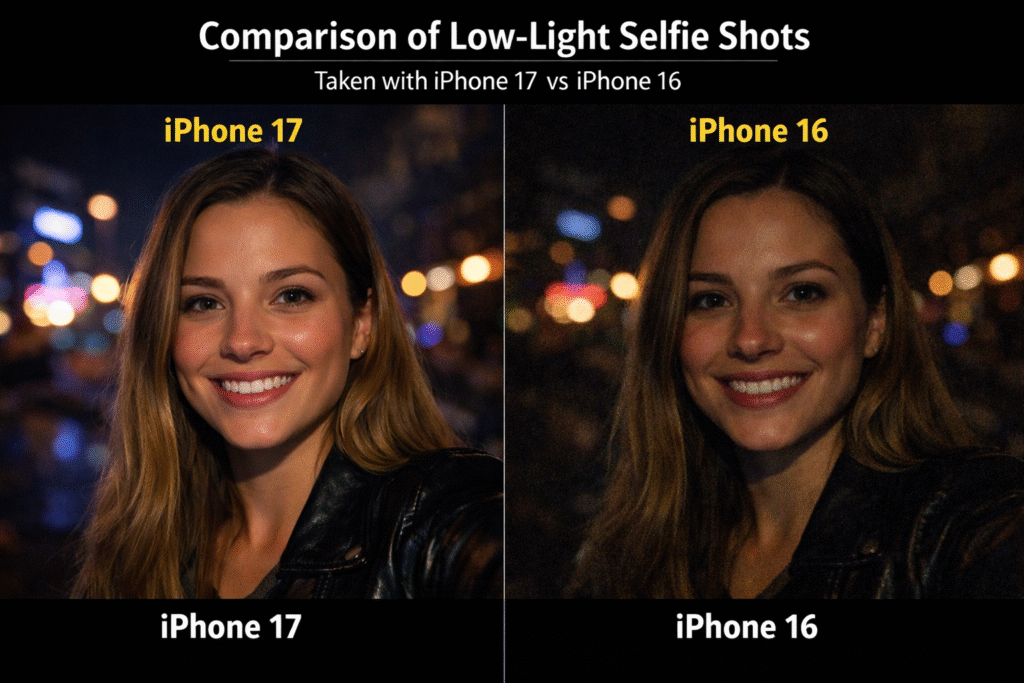
The iPhone 17 features a new 24MP selfie camera, doubling the resolution of the iPhone 16’s 12MP shooter. It’s not just about megapixels; the detail in Facetime calls and selfies is striking. In low light, the difference is night and day. The iPhone 17 captures sharp, well-lit selfies in dim bars or evening streets where the iPhone 16 would often produce grainy, soft images.
On the back, the Ultra Wide lens also gets bumped to 48MP on the iPhone 17. This is huge for macro photography and landscape shots. On the iPhone 16, cropping into an Ultra Wide shot usually resulted in a blurry mess. On the 17, you can crop in and still maintain crisp details.
Winner: iPhone 17 (especially for creators).
Battery Life and Charging
Battery anxiety is real, but both phones handle a full day with ease. In my testing, the iPhone 17 consistently ended the day with about 15-20% more battery than the iPhone 16.
This is likely down to the more efficient A19 chip and the LTPO display technology, which can dial the refresh rate down to 1Hz when you are just reading or looking at a static image. The iPhone 16 is stuck refreshing at 60Hz constantly, draining power unnecessarily.
Charging speeds have also seen a slight bump. The iPhone 17 supports faster MagSafe charging, which is great if you need a quick top-up before heading out. It’s not a revolutionary change, but every minute counts when you are at 5%.
Winner: iPhone 17.
The $949 Question: Is the Price Justified?
Here is where we need to do some math.
- iPhone 16 Launch Price: $799 (128GB)
- iPhone 17 Price: $949 (256GB)
The sticker shock of $949 is real, but look closer. The iPhone 17 starts at 256GB of storage. Apple used to charge $100 just to go from 128GB to 256GB. If you factor that in, the “real” price hike for the new tech (120Hz screen, better cameras, new chip) is effectively about $50.
When you frame it that way, $50 for ProMotion, a bigger battery, and a 24MP front camera is actually a solid deal. The problem is that Apple has removed the cheaper entry point. If you don’t need 256GB, you are forced to pay for it anyway.
Verdict: Who Should Upgrade?
The iPhone 17 is the phone we wanted the iPhone 16 to be. It finally bridges the gap between “standard” and “Pro.”
Upgrade to iPhone 17 if:
- You hold onto your phones for 3+ years. The 120Hz screen and 12GB RAM make it incredibly future-proof.
- You consume a lot of media. The screen upgrade is transformative.
- You take a lot of selfies or video calls. The 24MP camera is a noticeable leap.
- You need 256GB storage anyway.
Stick with (or Buy) iPhone 16 if:
- You are budget-conscious. You can likely find a new iPhone 16 for under $700 now, saving you $250+.
- You honestly don’t care about refresh rates. If you’ve never used a 120Hz screen, you won’t miss it.
- Your current phone (iPhone 14/15) is working fine. The leap is good, but maybe not $949 good if your current device is solid.
FAQ
Q: Does the iPhone 17 battery last significantly longer than the iPhone 16?
A: Yes, in real-world use. Thanks to the variable refresh rate display (LTPO) and the A19 chip efficiency, you can expect about 1-2 extra hours of active screen time per day compared to the iPhone 16.
Q: Will I actually notice the difference with the A19 chip?
A: For texting and social media? No. But if you play games, edit 4K video, or multitask heavily, the phone will feel snappier and stay cooler than the iPhone 16.
Q: Is the camera upgrade worth the money?
A: Only if you use the Ultra Wide or Front cameras often. The main 48MP shooter is very similar on both. The upgrade is mostly for selfie lovers and landscape photographers.
Q: Can I trade in my iPhone 16?
A: Absolutely. Most US carriers are offering aggressive trade-in deals right now. You could get up to $600-$700 credit for an iPhone 16 in good condition, bringing the iPhone 17 cost down to a much more manageable $250-$350.
Feel free to also check out official Apple comparison page here.
Content published by UpbeatUptake.com
About Us
Upbeat Uptake
Curated Insights and Updates
Hello, we are Upbeat Uptake, a simple blog focused on sharing clear ideas, useful updates and fresh perspectives. Our goal is to make information easy to understand and enjoyable to read.
We cover topics like technology, education, exams, gaming and current affairs, with an emphasis on clarity and relevance. Every post is created to inform, inspire and help you stay updated without unnecessary noise.
Follow Us
Social channels coming soon. Stay tuned for updates.
Leave a Reply