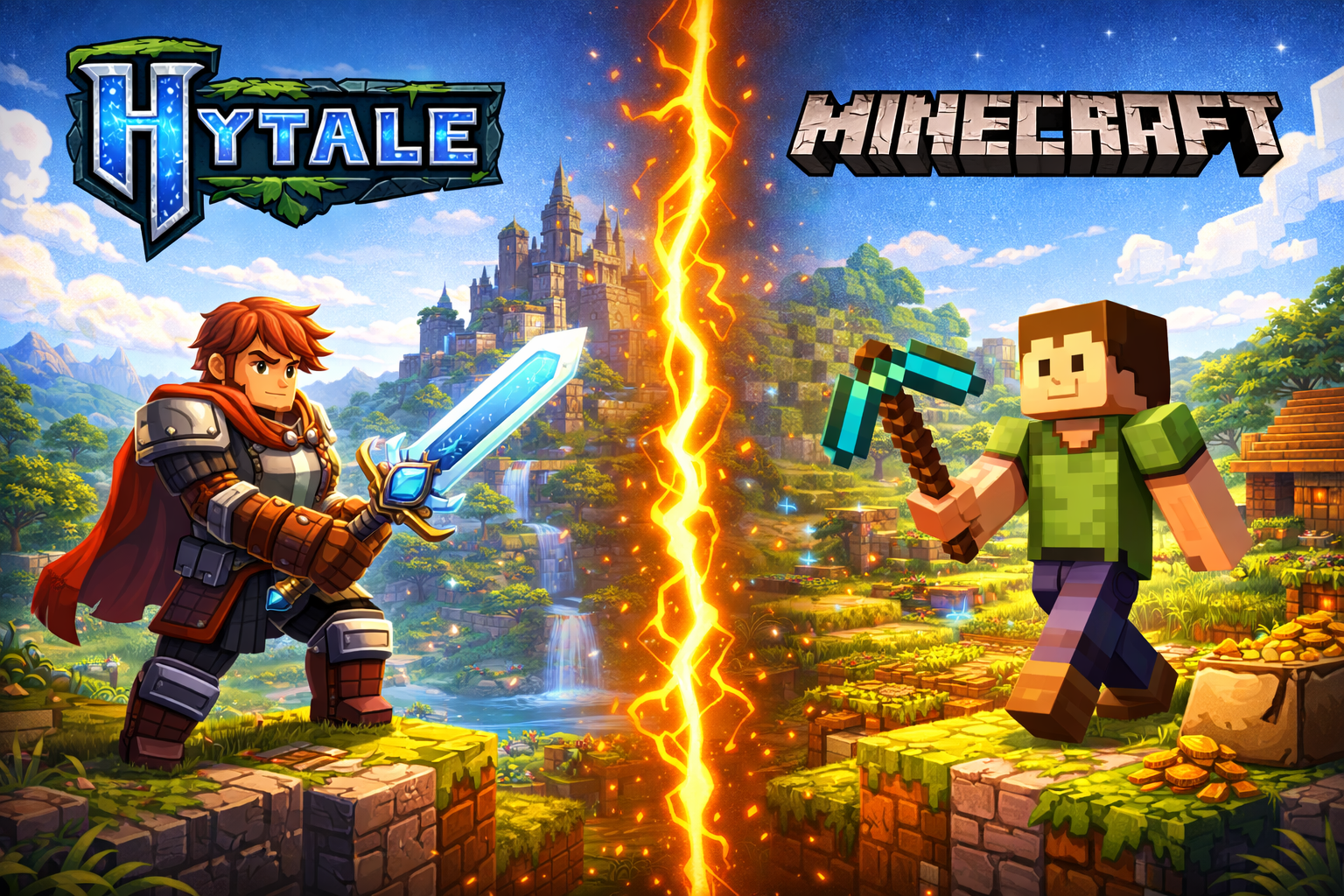
Hytale vs. Minecraft: 5 Major Differences You Need to Know

After years of anticipation, Hytale is finally launching in Early Access on January 13, 2026, positioning itself as a serious alternative to the legendary Minecraft. Developed by Hypixel Studios—the team behind Minecraft’s most popular server—Hytale promises to blend the creative freedom of sandbox games with the structured progression of RPG adventures.
But how different is Hytale from Minecraft? If you’ve spent years building in Minecraft’s blocky worlds, should you make the switch? This comprehensive guide breaks down the five major differences between these two voxel giants, helping you decide which game deserves your time in 2026.
What Makes Hytale Different from Minecraft?
While both games share the fundamental concept of block-based worlds, their design philosophies diverge significantly. Minecraft remains the ultimate creative sandbox where players define their own goals. Hytale, on the other hand, merges sandbox freedom with RPG structure, offering guided adventures alongside creative expression.
Let’s explore the five critical differences that set these games apart.
1. Game Philosophy: Pure Sandbox vs. RPG-Sandbox Hybrid
Minecraft’s Approach: Absolute Freedom
Minecraft has built its empire on one simple principle: complete player freedom. When you spawn in a Minecraft world, there’s no tutorial, no quest markers, and no predetermined path. You punch a tree, craft tools, and create your own adventure. This design has remained largely unchanged since 2011, cementing Minecraft as the digital equivalent of LEGO bricks.
The game offers minimal structure beyond basic progression milestones (Nether, End Dragon). Everything else—building cities, creating redstone machines, or establishing kingdoms—comes entirely from player imagination. This open-ended approach appeals to creative builders and those who enjoy defining their own objectives.
Hytale’s Approach: Guided Adventure Meets Creative Freedom
Hytale takes a fundamentally different path by combining sandbox creativity with structured RPG elements. The game features a complete narrative campaign, quest systems, NPC factions with evolving relationships, and zone-based progression that guides players through increasingly challenging content.
Players can choose their playstyle—settler, adventurer, or craftsperson—while progressing through a story-driven adventure mode. The game world is divided into distinct zones (four available at Early Access launch, six planned total), each with unique environmental challenges, creatures, and lore. This structure provides clear goals and rewards while maintaining the creative freedom that sandbox fans expect.
The key difference? Hytale offers purpose alongside freedom. Players who felt lost in Minecraft’s endless expanse will appreciate the direction, while creative builders still have access to powerful tools for unrestricted building.
Winner: Depends on preference. Choose Minecraft for pure sandbox freedom; choose Hytale for guided adventure with creative options.
2. Combat System: Simple vs. Skill-Based Mechanics
Minecraft Combat: Functional But Basic
Minecraft’s combat system received a major overhaul in version 1.9, introducing cooldown-based attacks to replace mindless click-spam. The current system includes:
- Weapon cooldown timers that require strategic timing
- Shield blocking for defensive play
- Basic weapon variety (swords, axes, tridents, bows)
- Enchantment system for gear progression
- Straightforward hitbox mechanics
While this system works adequately, combat remains secondary to Minecraft’s core building and exploration focus. Enemy AI follows simple patterns, PvP lacks depth, and most encounters can be won through gear advantages rather than player skill.
Hytale Combat: Dynamic and Mechanically Rich
Hytale’s combat system represents a dramatic evolution, built from the ground up to rival action RPGs. The developers have implemented:
Directional Combat: Attacks have directional properties, rewarding proper positioning and timing rather than just clicking faster.
Active Defense: Players can dodge roll, block with shields or weapons, and parry incoming attacks, creating a skill-based defensive layer.
Weapon-Specific Movesets: Each weapon type (swords, hammers, daggers, bows, staffs) plays distinctly differently. Hammers deliver slow, crushing blows; daggers enable quick strikes and mobility; staffs channel elemental magic.
Combo System: Chaining attacks together creates combo sequences that deal bonus damage, encouraging aggressive play and rewarding mastery.
Magic Integration: Full elemental spell systems allow players to specialize in magical combat styles alongside traditional melee and ranged weapons.
Advanced Enemy AI: Creatures employ tactical behaviors including flanking maneuvers, blocking attacks, and coordinated group tactics. This creates genuine challenges that require player adaptation rather than simple gear checks.
The stamina system adds another layer—sprinting and combat actions consume stamina, forcing players to manage their energy during extended fights. Food items restore health rather than filling a hunger bar, making combat encounters more tactical and punishing.
Winner: Hytale, without question. The combat depth appeals to action RPG fans while maintaining accessibility for casual players.
3. Graphics Engine: Java Limitations vs. Modern C++ Power
Minecraft’s Technical Constraints
Minecraft Java Edition runs on a 15-year-old codebase that, while iconic, shows its age in performance. The Java-based engine faces several inherent limitations:
Performance Bottlenecks: Even on powerful gaming PCs, vanilla Minecraft struggles with render distances beyond 16-32 chunks. The single-threaded architecture means one CPU core does most work while others remain underutilized.
Memory Management Issues: Java’s garbage collection system causes periodic frame stutters during gameplay, particularly in modded environments or when exploring new terrain.
Optimization Dependency: Players rely on community-developed mods like Optifine or Sodium to achieve acceptable performance. These mods can double or triple frame rates, revealing how unoptimized the base game remains.
Platform Limitations: The Java edition runs primarily on PC, while console players must use the separately developed Bedrock Edition with different features and limitations.
Hytale’s Next-Generation Engine
Hypixel Studios made the controversial decision to completely rebuild Hytale’s engine in C++, delaying the game by years. The payoff, however, is substantial:
Massive Render Distances: The C++ engine supports 64+ chunk render distances without performance degradation, allowing players to see entire zones from mountaintops.
Superior Memory Management: Direct memory control eliminates garbage collection stutters, providing smooth, consistent frame rates even during intensive gameplay.
Native Cross-Platform Support: The engine runs natively on PC, with console and mobile versions planned. Unlike Minecraft’s fragmented editions, Hytale will support true cross-play with unified features across all platforms.
Advanced Graphics Features: Built-in support for real-time global illumination, volumetric fog and clouds, dynamic weather systems, and particle physics at scale.
Load Time Improvements: Initial world loading reduced from 30-60 seconds (Minecraft) to 5-10 seconds (Hytale), with faster chunk loading during exploration.
The performance difference is stark. While Minecraft requires 8GB+ RAM and still experiences stuttering, Hytale targets 4-6GB usage with consistently higher frame rates. The entity limit jumps from ~500 in Minecraft to 5,000+ in Hytale, enabling massive battles and complex scenes without performance collapse.
Winner: Hytale’s modern engine provides objective technical advantages, though Minecraft’s simplicity has charm and universal device compatibility.
4. World Generation: Infinite Repetition vs. Zone-Based Diversity
Minecraft’s World Generation
Minecraft pioneered procedural world generation in gaming, creating theoretically infinite worlds from random seeds. The system generates:
- Diverse biomes (forests, deserts, mountains, oceans, caves)
- Natural structures (villages, temples, strongholds, bastions)
- Underground cave systems and ravines
- The Nether and End dimensions for progression
The fundamental limitation? Repetition. Once you’ve explored one Plains biome, you’ve essentially seen them all. Desert temples follow identical layouts. Villages use the same building templates. The procedural generation creates vast spaces that feel samey after extended play.
Recent updates added improved cave generation and mountain heights, but the core problem persists—Minecraft worlds prioritize infinite scale over unique, memorable locations.
Hytale’s Zone-Based World Generation
Hytale employs a fundamentally different approach through its zone system. The planet Orbis consists of six distinct zones, each with completely unique content:
Zone 1 – Emerald Grove: Temperate forests, winding caves, friendly NPC villages, introductory difficulty level.
Zone 2 – Howling Sands: Desert biomes, ancient ruins, sandstorms, nomadic NPC factions, increased challenge.
Zone 3 – Borea: Frozen tundra, icy mountains, subterranean forests, yeti encounters, harsh survival conditions.
Zone 4 – Devastated Lands: Corrupted environments, dangerous monsters, high-level rewards, post-apocalyptic atmosphere.
Each zone features:
- Unique Asset Sets: Every zone has distinct blocks, trees, rocks, creatures, NPCs, furniture sets, and environmental props. The aesthetic completely changes between zones.
- Custom Biome Rules: Rather than random biome placement, each zone contains hand-crafted biome configurations that create cohesive regional identities.
- Hand-Designed Dungeons: Unlike Minecraft’s simple dungeons, Hytale features multi-chamber prefabricated dungeons with hand-placed encounters, puzzles, and boss rooms designed by the development team.
- 3,785+ Unique Prefabs: The world generation draws from thousands of custom-built structures ranging from environmental details (trees, rock formations) to complete ruins, buildings, and special encounter areas.
- NPC Faction Politics: Each zone hosts different NPC races with their own cultures, conflicts, and relationship systems that respond to player actions.
- Progressive Difficulty: Zones function as natural progression tiers. Players begin in Zone 1 and work toward the increasingly challenging outer zones.
The Deep Ocean and Infinite Lands: Beyond the starting continent lies the ocean shelf—a dramatic drop-off leading to the dangerous deep ocean zone. Beyond that, infinite procedural terrain ensures endless exploration for dedicated players.
This zone-based approach creates memorable, distinct locations rather than endless sameness. Each zone feels like a complete new game environment with unique rules, challenges, and aesthetics.
Winner: Hytale. The zone system delivers curated, diverse experiences that Minecraft’s pure procedural generation cannot match.
5. Modding Philosophy: Community Chaos vs. Official Integration
Minecraft’s Community-Driven Modding
Minecraft’s modding community stands among gaming’s most prolific, with tens of thousands of mods created over 15+ years. However, the process remains fundamentally janky:
Client-Side Installation: Players must manually download mod files, ensure version compatibility, install mod loaders (Forge, Fabric, Quilt), and pray everything works together without conflicts.
Version Fragmentation: Major Minecraft updates often break mods, forcing players to wait months for mod developers to update their work. Many beloved mods are abandoned when developers move on.
No Official API: Mojang has never provided official modding support. Modders reverse-engineer the game code, creating a fragile ecosystem that requires constant maintenance.
Server-Client Matching: Joining modded servers requires players to manually install matching mod packs—a process that confuses newcomers and creates barriers to multiplayer modded experiences.
Performance Issues: Many mods conflict or cause performance problems, especially in large mod packs. Players spend as much time troubleshooting as playing.
Despite these challenges, Minecraft’s modding scene thrives due to sheer community dedication and the game’s long history.
Hytale’s Official Server-Side Modding
Hytale implements a revolutionary approach that prioritizes security, accessibility, and creator empowerment:
Server-Side Architecture: All mods run on the server, not the client. When you join a modded Hytale server, the game automatically downloads necessary assets (models, textures, sounds) and loads gameplay modifications without any manual installation.
One-Click Modded Servers: Players click join, and the server streams the modded experience directly to their client. No launcher configuration, no file management, no compatibility checking. This removes the biggest barrier preventing casual players from experiencing modded content.
Official Java Plugin API: Server owners write plugins in Java using official APIs, accessing powerful server-side functionality for creating minigames, economies, custom commands, and gameplay modifications.
Visual Scripting System: Non-programmers can create complex game logic using node-based visual scripting inspired by Unreal Engine Blueprints, dramatically expanding the creator base.
Hytale Model Maker: A browser-based 3D modeling, texturing, and animation toolkit allows creators to design custom assets without external software, then import directly into the game.
Security-First Design: By restricting mods to server-side execution, Hytale eliminates client-side security risks that plague Minecraft (malware, unauthorized client modifications, cheating).
Hot-Reloading: Creators can edit scripts while the game runs, seeing changes immediately without restarting—a workflow that accelerates mod development exponentially.
Trade-Offs: The server-side approach means certain Minecraft mod types won’t exist in Hytale—specifically, client-side visual modifications like shaders or personal quality-of-life improvements that only affect your view. Hytale’s developers believe server-driven systems can replicate these features while maintaining security and unified experiences.
The modding philosophy difference is stark: Minecraft trusts players to manage everything manually; Hytale controls the environment to ensure seamless, secure experiences.
Winner: Mixed. Hytale for ease of use and security; Minecraft for maximum freedom and established mod ecosystem.
Creative Mode & Building Tools Comparison
Beyond the five major differences above, the creative modes deserve special mention.
Minecraft Creative Mode
Minecraft’s creative mode provides:
- Unlimited blocks from a complete inventory
- Flight for easy construction
- Invincibility (no damage, no death)
- Basic copy/paste tools (structure blocks)
- Redstone systems for mechanical builds
While functional, Minecraft’s creative tools show their age. Large-scale building requires tedious block-by-block placement or complex command block setups.
Hytale Creative Mode
Hytale Creative Mode functions more like a professional game development toolkit:
Advanced Terrain Tools: Scripted brushes instantly create mountains, valleys, rivers, and paths. The shape brush generates spheres, pyramids, cones, and walls with customizable materials, density, and masks.
Prefab Browser/Editor: Load, edit, and place thousands of pre-built structures. Save your own creations as prefabs for reuse across worlds.
Selection Tool: Select 3D regions to move, copy, rotate, save, regenerate, or extrude. Future updates will add freeform selection and “magic wand” tools for selecting all blocks of the same type.
Collaborative Building: Multiple players can build simultaneously in the same creative world with permission systems (Owner, Builder, Decorator, Viewer roles).
Machinima Tools: Create camera actors, set keyframes, control movement speed for cinematic shots and timelapses. Professional-grade video creation tools built into the game.
Customizable Flight: Adjust flight speed, inertia, hover vs. directional movement, and stopping behavior to match your building style.
Laser Pointer & Ruler: Point out areas to teammates and measure distances with guide lines for precise construction.
The creative mode comparison isn’t close—Hytale provides professional-level tools where Minecraft offers basic functionality.
Which Game Should You Play in 2026?
Choose Minecraft If:
- You value complete creative freedom without structured goals
- You prefer simple, accessible combat mechanics
- You want to join an established community with 15+ years of content
- You enjoy the nostalgic, iconic aesthetic
- You’re interested in the massive existing mod ecosystem (despite its complexity)
- You play on lower-end devices or mobile platforms
- You prefer infinite, procedurally generated worlds
Choose Hytale If:
- You want RPG progression and narrative alongside sandbox building
- You enjoy skill-based, mechanically deep combat systems
- You appreciate modern graphics and optimized performance
- You prefer curated, diverse zones over infinite repetition
- You want easy access to modded content without technical hassles
- You’re excited to be part of a new game’s launch community
- You value official creative tools and built-in modding support
Can You Play Both?
Absolutely. These games scratch different itches. Minecraft remains unmatched for pure creative expression and nostalgic charm. Hytale offers structured adventure and modern systems for players seeking more depth.
The “competition” between them benefits players—Minecraft will continue evolving in response to Hytale’s innovations, while Hytale will learn from Minecraft’s 15 years of community wisdom.
Hytale Early Access: What to Expect
Before you rush to pre-order, understand that Hytale’s January 13, 2026 early access launch will be genuinely early. The developers have been transparent about this:
What’s Included at Launch:
- Exploration Mode with four zones (Emerald Grove, Howling Sands, Borea, Devastated Lands)
- Full Creative Mode with building and terrain tools
- Multiplayer servers and minigames
- Day-one modding tools and APIs (still maturing)
- Cross-play foundations (Windows only at launch)
What’s Missing at Launch:
- Complete Adventure Mode with full narrative and dungeon content
- Zones 5 and 6
- Console and mobile versions
- Final polish and bug fixes
- Complete modding tool maturity
The development team explicitly warns that “the first impression will be rough” and that the game “will be buggy for a while.” They returned to a four-year-old prototype build after reacquiring the game from Riot Games, meaning some systems feel less refined than expected.
Pricing: Standard Edition ($19.99), Supporter Edition ($34.99), Cursebreaker Edition ($69.99). Pre-orders open December 13, 2025.
If you’re patient, waiting 6-12 months after early access launch might provide a more polished experience. If you enjoy participating in game development and providing feedback, jumping in day one offers the chance to shape Hytale’s future.
Final Verdict: Evolution, Not Replacement
Hytale isn’t trying to kill Minecraft—it’s evolving the voxel sandbox genre in new directions. Where Minecraft perfected creative freedom and emergent gameplay, Hytale adds structured adventure, modern technology, and official creator support.
The five major differences—game philosophy, combat depth, engine technology, world generation approach, and modding systems—create fundamentally distinct experiences. Minecraft will remain the king of pure sandbox creativity. Hytale aims to become the premier choice for players seeking depth, progression, and adventure within a blocky world.
For gamers in 2026, the question isn’t “Hytale or Minecraft?” It’s “When will I have time to play both?”
The voxel sandbox genre just got infinitely more interesting.
Frequently Asked Questions
Q: Will Hytale replace Minecraft?
A: No. Minecraft has 15+ years of established community, content, and cultural significance. Hytale offers an alternative experience rather than a replacement. Both games will coexist, serving different player preferences.
Q: Can I play Hytale for free?
A: No. Hytale is buy-to-play with a one-time purchase starting at $19.99. There are no subscriptions or pay-to-win mechanics.
Q: Will Hytale have cross-play between PC and consoles?
A: Yes, eventually. The C++ engine supports cross-platform play, but console versions will come after the PC early access period.
Q: Can I transfer my Minecraft worlds to Hytale?
A: No. The games use completely different engines and world formats. You’ll start fresh in Hytale.
Q: Is Hytale better than Minecraft?
A: “Better” is subjective. Hytale offers more structured gameplay, better combat, and modern technology. Minecraft offers unmatched creative freedom and an established ecosystem. Your preference depends on what you value in sandbox games.
Q: Will Minecraft get updates to compete with Hytale?
A: Minecraft continues receiving regular updates. Mojang has shown willingness to evolve based on community feedback and competition. Hytale’s launch will likely accelerate Minecraft’s innovation.
Q: Can I create mods for Hytale without programming knowledge?
A: Yes. Hytale includes visual scripting tools and Hytale Model Maker for creating content without coding. Advanced features still require Java programming knowledge.
Q: When will Hytale fully release (not early access)?
A: Unknown. The developers haven’t provided a timeline for leaving early access. Based on similar games, expect 1-3 years of early access development.
Want to stay updated on Hytale’s development? Visit the official Hytale website for news, blog posts, and community updates. For Minecraft, check out Minecraft.net for the latest patch notes and announcements.
Which game will you choose? Share your thoughts in the comments below!
Content published by UpbeatUptake.com
About Us
Upbeat Uptake
Curated Insights and Updates
Hello, we are Upbeat Uptake, a simple blog focused on sharing clear ideas, useful updates and fresh perspectives. Our goal is to make information easy to understand and enjoyable to read.
We cover topics like technology, education, exams, gaming and current affairs, with an emphasis on clarity and relevance. Every post is created to inform, inspire and help you stay updated without unnecessary noise.
Follow Us
Social channels coming soon. Stay tuned for updates.
Leave a Reply