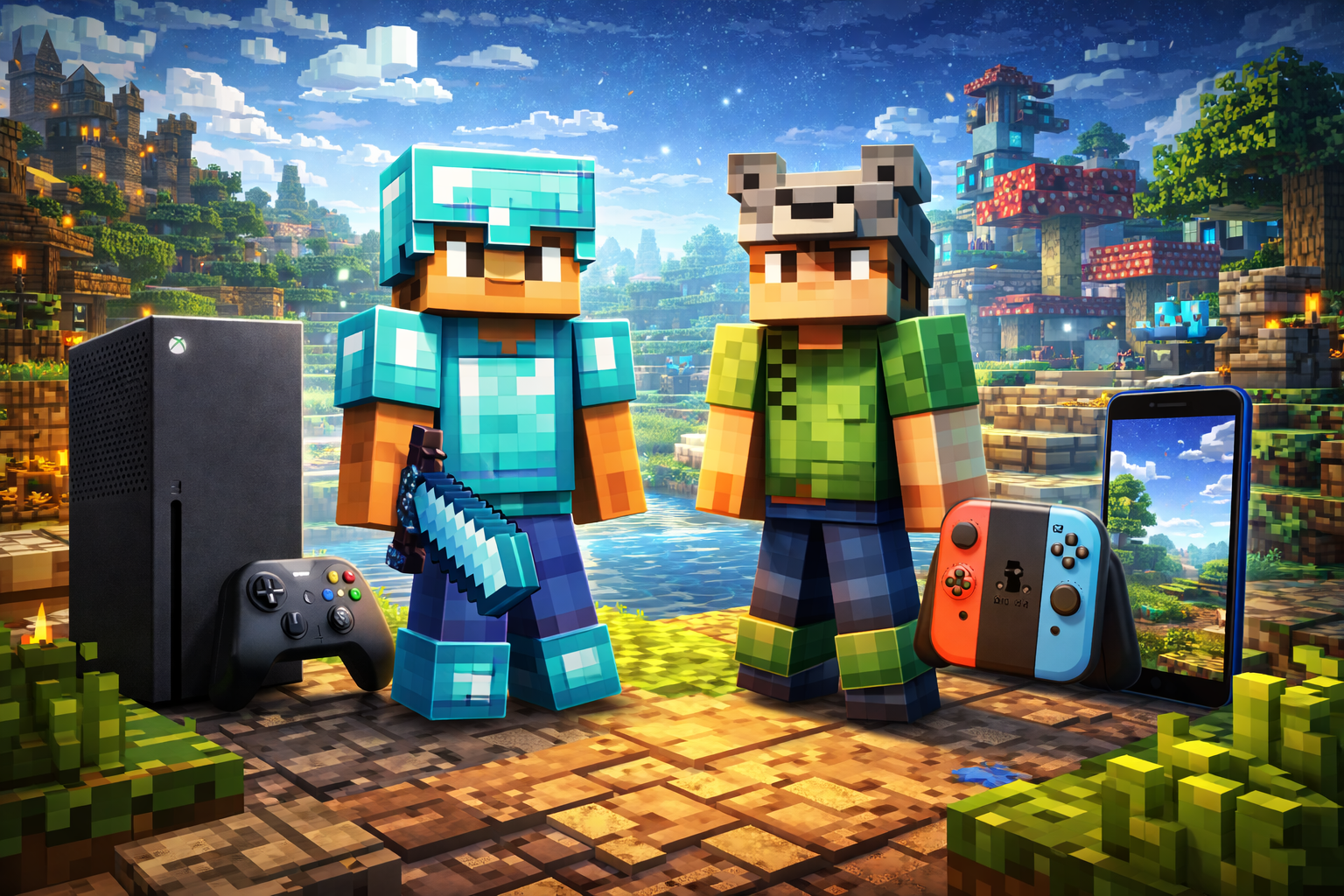
Why Does Bedrock Edition Exist? A Clear Explanation for Minecraft Players

Many Minecraft players, especially beginners, ask a simple but important question: why does Bedrock Edition exist when Java Edition already exists? At first glance, having two versions of the same game can feel confusing. However, Bedrock Edition was created for very specific technical, business, and player-experience reasons.
In this article, we explain why Minecraft Bedrock Edition exists, how it differs from Java Edition, and why both versions continue to be developed side by side.
The Short Answer
Bedrock Edition exists because Java Edition could not scale efficiently to consoles, mobile devices, and cross-platform multiplayer. Mojang needed a version of Minecraft that could run smoothly on many types of hardware while supporting millions of players across different platforms.
The Original Minecraft: Java Edition
Minecraft originally launched as entity[“video_game”,”Minecraft Java Edition”,”pc version”], written in the Java programming language.
Java Edition offered:
- Deep modding support
- Powerful community-made servers
- Flexible customization
However, Java also had limitations:
- Higher performance cost on low-end devices
- Poor compatibility with consoles and mobile platforms
- Difficult cross-platform networking
As Minecraft grew globally, these limitations became more obvious.
Why Java Was Not Enough
Java works well on PCs, but it struggles in environments where:
- Hardware resources are limited (phones, tablets)
- Battery efficiency matters
- Platform owners require strict performance and security rules
Consoles like Xbox and PlayStation do not support Java-based games natively. Mobile devices also cannot efficiently run Java-based Minecraft worlds at scale.
To reach a broader audience, Mojang needed a different technical foundation.
The Birth of Bedrock Edition
Bedrock Edition was built using C++, a faster and more hardware-efficient language than Java.
This allowed Mojang to:
- Release Minecraft on mobile devices
- Bring Minecraft to consoles
- Improve performance and stability
- Standardize gameplay across platforms
What began as Pocket Edition eventually evolved into what we now call entity[“video_game”,”Minecraft Bedrock Edition”,”cross platform version”].
Cross-Platform Play Was the Main Goal
One of the biggest reasons Bedrock Edition exists is cross-platform multiplayer.
With Bedrock Edition:
- Mobile players can play with console players
- Console players can join friends on Windows PCs
- Updates roll out at the same time across platforms
This unified ecosystem would not have been possible with Java Edition.
Performance and Optimization Benefits
Bedrock Edition is designed to run efficiently on a wide range of devices.
Key performance advantages include:
- Better frame rates on low-end hardware
- Faster world loading
- Lower memory usage
- Improved battery efficiency on mobile
This makes Bedrock the default choice for many casual players and younger audiences.
Why Bedrock Has Fewer Mods Than Java
A common criticism is that Bedrock has limited modding compared to Java.
This is intentional.
Bedrock prioritizes:
- Stability
- Security
- Platform compliance
Instead of full mods, Bedrock uses add-ons, which limit how deeply players can change game mechanics. This ensures fair gameplay across consoles and prevents malicious code from spreading through the ecosystem.
The Minecraft Marketplace
Another reason Bedrock Edition exists is the Marketplace.
The Marketplace allows:
- Curated content packs
- Paid skins, maps, and add-ons
- Revenue sharing with creators
This system works best in a controlled environment, which is easier to manage with Bedrock’s architecture.
Why Java Edition Still Exists
If Bedrock is faster and more scalable, why keep Java Edition?
Because Java serves a different audience:
- Modders
- Technical players
- Large custom servers
- Redstone engineers
Java Edition remains the most flexible and community-driven version of Minecraft, and Mojang continues to support it alongside Bedrock.
Java vs Bedrock: Different Goals
| Feature | Java Edition | Bedrock Edition |
|---|---|---|
| Primary platform | PC | Mobile, Console, PC |
| Modding freedom | Very high | Limited |
| Performance | Hardware-dependent | Highly optimized |
| Cross-platform | No | Yes |
| Marketplace | No | Yes |
So, Why Does Bedrock Edition Exist?
In simple terms:
- Java Edition exists for freedom and customization
- Bedrock Edition exists for accessibility, performance, and scale
Both versions solve different problems, which is why neither has replaced the other.
Frequently Asked Questions
Is Bedrock replacing Java Edition?
No. Mojang has repeatedly confirmed that both versions will continue to be supported.
Is Bedrock better than Java?
Neither is objectively better. The best version depends on how and where you play.
Why do updates sometimes differ?
Different codebases mean updates must be implemented separately, even if features are similar.
Final Thoughts
Bedrock Edition exists because Minecraft needed to grow beyond PCs. Without it, Minecraft would not be playable on phones, consoles, or across platforms. Java Edition remains essential for creativity and modding, while Bedrock ensures Minecraft is accessible to the widest possible audience.
Understanding why both versions exist helps players choose the edition that best fits their playstyle.
Content published by UpbeatUptake.com
About Us
Upbeat Uptake
Curated Insights and Updates
Hello, we are Upbeat Uptake, a simple blog focused on sharing clear ideas, useful updates and fresh perspectives. Our goal is to make information easy to understand and enjoyable to read.
We cover topics like technology, education, exams, gaming and current affairs, with an emphasis on clarity and relevance. Every post is created to inform, inspire and help you stay updated without unnecessary noise.
Follow Us
Social channels coming soon. Stay tuned for updates.
Leave a Reply